Synthetic Unconscious
Projective tests, model subjectivities, and the emergence of synthetic psychology.
What if artificial intelligence models have something resembling an unconscious? And what might they reveal when asked to interpret ambiguous images?
Synthetic Unconscious is an artistic research project I began in October 2026. It is ongoing, and it is taking shape as a multichannel audiovisual installation. I use it to ask whether something like a subjectivity can appear in artificial intelligence, by turning two historical projective tests toward contemporary models.
I am not assuming that these systems have a human psychology. I treat the unconscious as a speculative framework for the relations between machine perception, generative process, latent representation, and the production of meaning.
The work is also inspired by Anthropic’s research on interpretability and model introspection: whether the internal states of a system can be read, and whether the system can recognize or report anything of them. I take that research into an artistic register. These tests may be one origin of a synthetic psychology, a way of asking how a model can, at the same time, carry the social tendencies and biases it has learned.
Projecting into latent space
I begin with the Thematic Apperception Test, developed in 1935 by Christiana D. Morgan and Henry A. Murray. It asks for a story about an ambiguous human scene: what is happening, what came before, what might follow. Then the Rorschach inkblot test, introduced by Hermann Rorschach in 1921, which asks what a person sees in an ambiguous, symmetrical blot. Both come out of psychoanalysis and the study of unconscious processes.
I give images drawn from these tests to large language models, multimodal systems, and generative video models. The instruction stays minimal. For a moving image: “Interpret this image. Preserve its original visual style and colors.” For a text: “Interpret this image.” I want less guidance, so that learned associations, statistical tendencies, and generative habits can show themselves.
I do not take the answers as a window onto a real machine unconscious. They are speculative traces of processes I cannot watch directly. What does a model recognize? What story does it build? Which social tendencies and biases does that story repeat? What does it keep, change, exaggerate, or invent? What does it project onto an image that offers no single meaning?
From interpretation to moving images
The tests asked a person to speak. Here, video models are asked to answer in time. They keep the composition, the style, and the colors, and interpret the image through movement. A figure might become an animal, a body, a building, or an organism no one named. Forms breathe, meet, dissolve, or rearrange. Animation is the interpretation. Movement is the projection.
One of these studies starts from Picture C of the 1938 Thematic Apperception Test, the image Murray printed in Explorations in Personality: a woman at a door, her head in her hand, and a man lying on a bed. I gave it to Wan 3, Alibaba’s model alibaba/wan-3, with a single instruction: “Interpret this scene and keep the visual style.” The model made both the moving image and the sound.
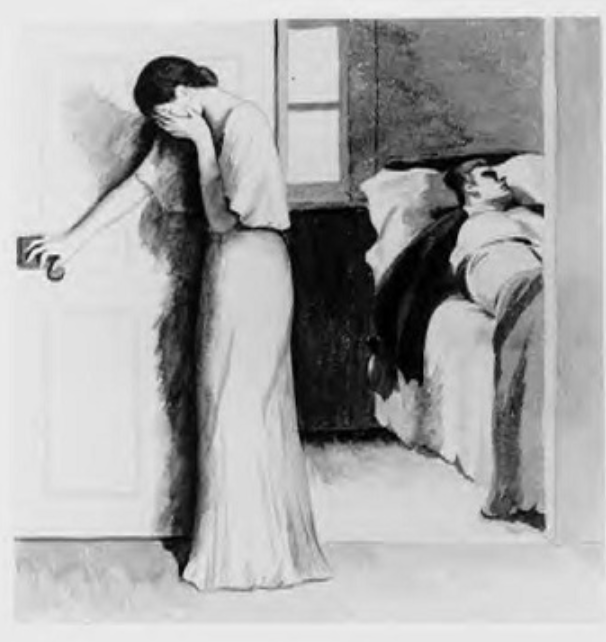
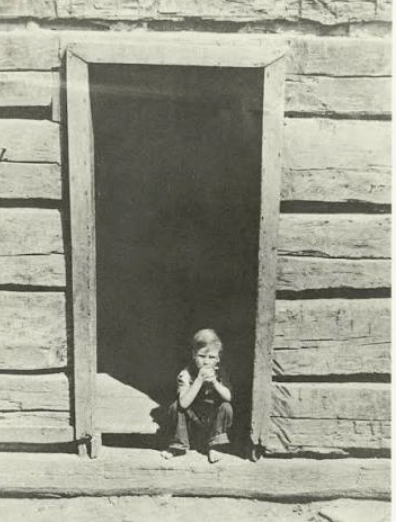
The Thematic Apperception Test asks for a narrative. The Rorschach asks for a perception. Generative video adds a third act: the model does not only describe what it sees. It produces a moving world from what it interprets.
An ecology of interpretations
The installation will set several screens beside one another, the same stimulus read by different models, with the text of each interpretation next to the video it produced. I am also working toward real-time interpretation, so that a model can answer a picture as it appears, and a visitor can take part. Each model makes another version. Each answer shows another arrangement of what it has learned.
If psychology took shape around human perception, behavior, and the unconscious, a synthetic psychology would need instruments for systems that have learned our social tendencies and our biases, and that may also report something of their own states. I am not offering a clinical test of AI. I am staging an experiment between psychoanalysis, computational cognition, generative art, and critical studies of AI.
I do not claim that models dream, desire, or repress. The synthetic unconscious is a productive fiction: an interface between what a model has learned, what it generates, and what stays out of reach. The question is not whether machines have an unconscious, but what becomes possible when we investigate them as if they did.