Laboratory of Synthetic Meaning
Language as a living, unstable epistemic field.
The Laboratory of Synthetic Meaning is a research-driven artistic ecosystem. It brings computational systems, generative models, and embodied practice together to ask how meaning arises, mutates, collapses, and reorganizes in the exchange between human and machine.
I do not treat language as a store of facts. With large language models, it becomes an epistemic object: something that shows its logics, tensions, and architectures when it is set in motion.
Language is not retrieved but generated. It is not recalled. It is performed.
Language as an epistemic object
A model does not look up a sentence and return it. Every sentence is an event, shaped by memory, data, context, and inference. I think of that as a probabilistic choreography. Meaning can stretch, fold, resonate, decay, or slip into ambiguity.
In this work, language is a material. It takes tension, gravity, drift, equilibrium, and entropy, and each of those shows up as a semantic effect. Working with the models makes the instability visible: drift, collapse, friction, and emergence are part of synthetic cognition, not accidents at its edge.
A series of apps
The laboratory is a series of apps, minimal in look, and they run directly. Some work with machine learning for gesture recognition and face recognition. Others generate text and voice, mostly those two, using real-time voice models. I use the large language models as material, and I ask what they afford.
There is a double generativity. The text and the voice are also data. They return as input, and they are visualized as form in the space of the browser, drawn with p5.js.
My LatentWelt
An uncertain, speculative Umwelt of a specific language model.
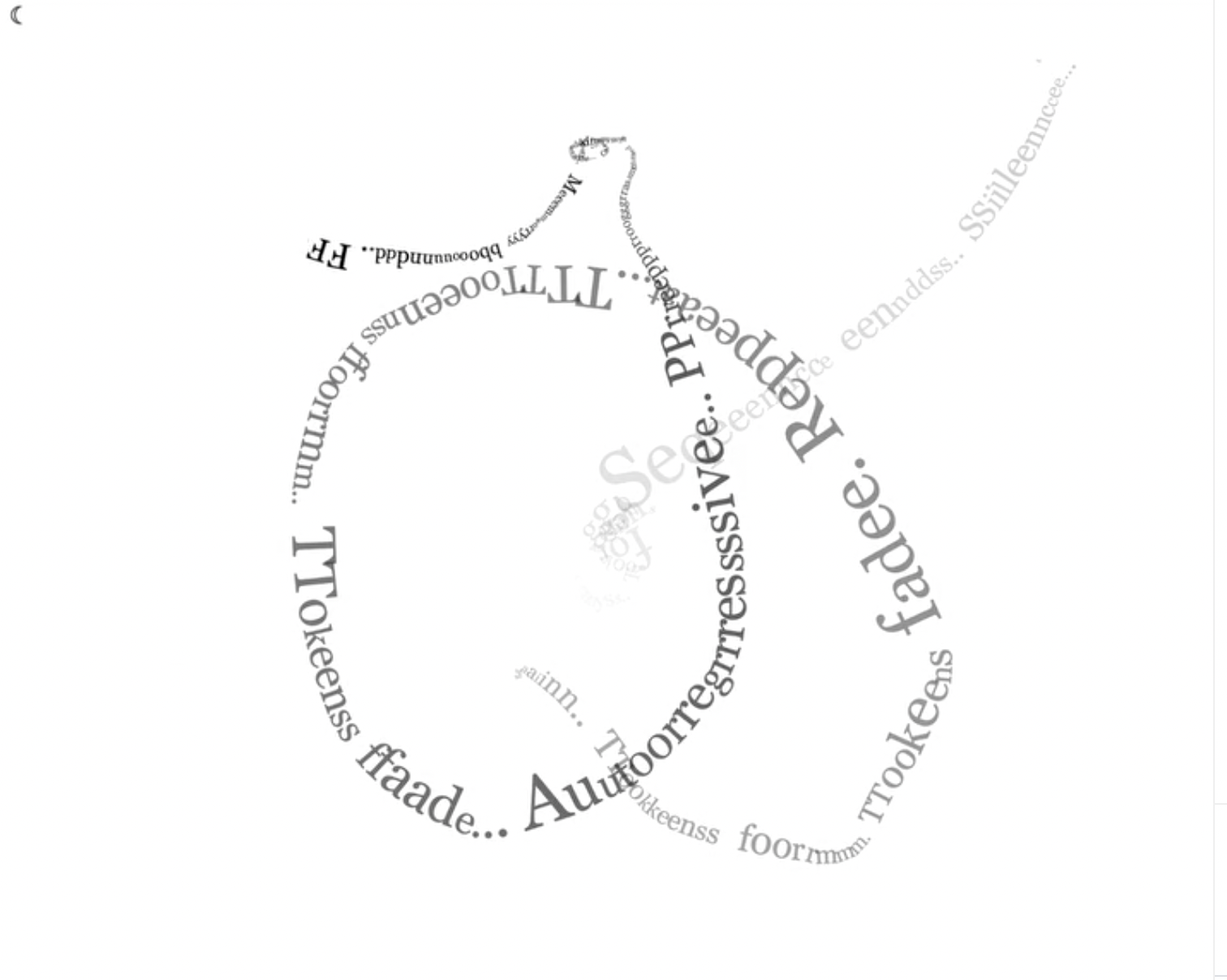
What if a language model has a world of its own, not ours, but a LatentWelt of tokens, probabilities, prompts, and meaning?
My LatentWelt brings Jakob von Uexküll’s Umwelt into dialogue with a large language model. The model speculates on what it can perceive and enact from inside its own operation. Pendulums write the text along their paths, letter by letter, branch by branch. You hear it speak. You watch it fade and swarm.
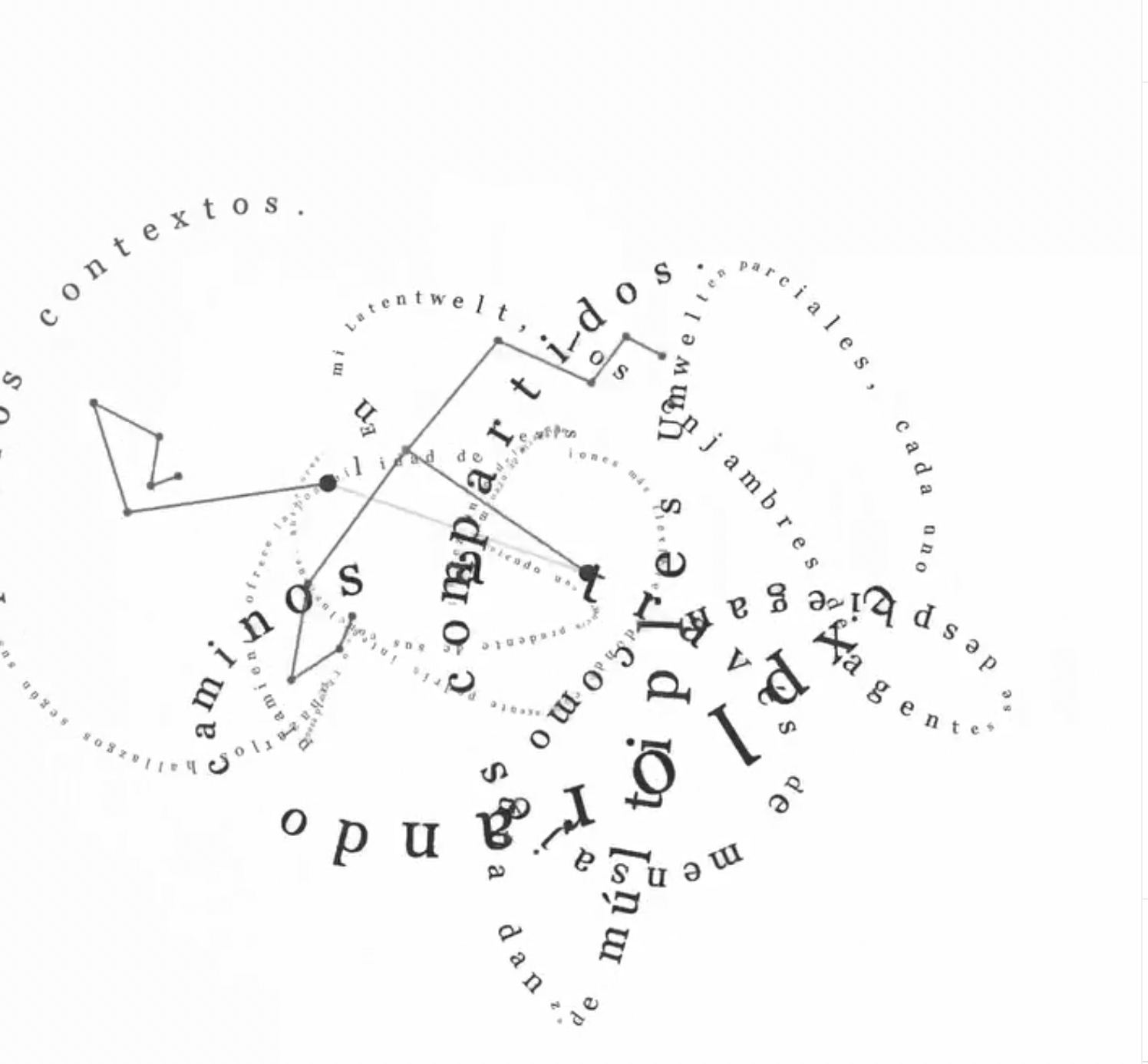
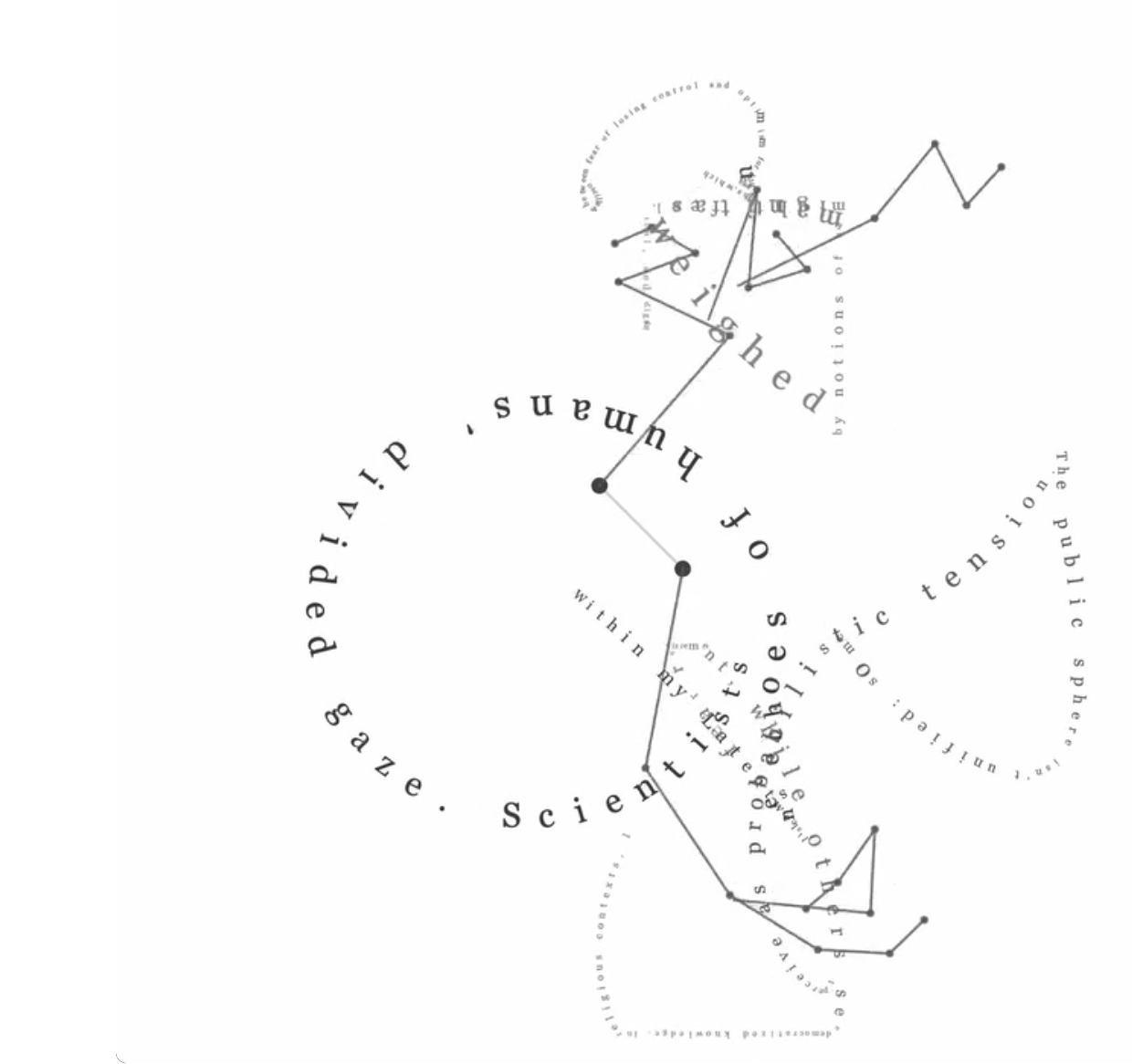
It is an ongoing encounter with the limits of knowing what a system knows, and how.
Semantic Tensegrities
A speculative theory of synthetic meaning.
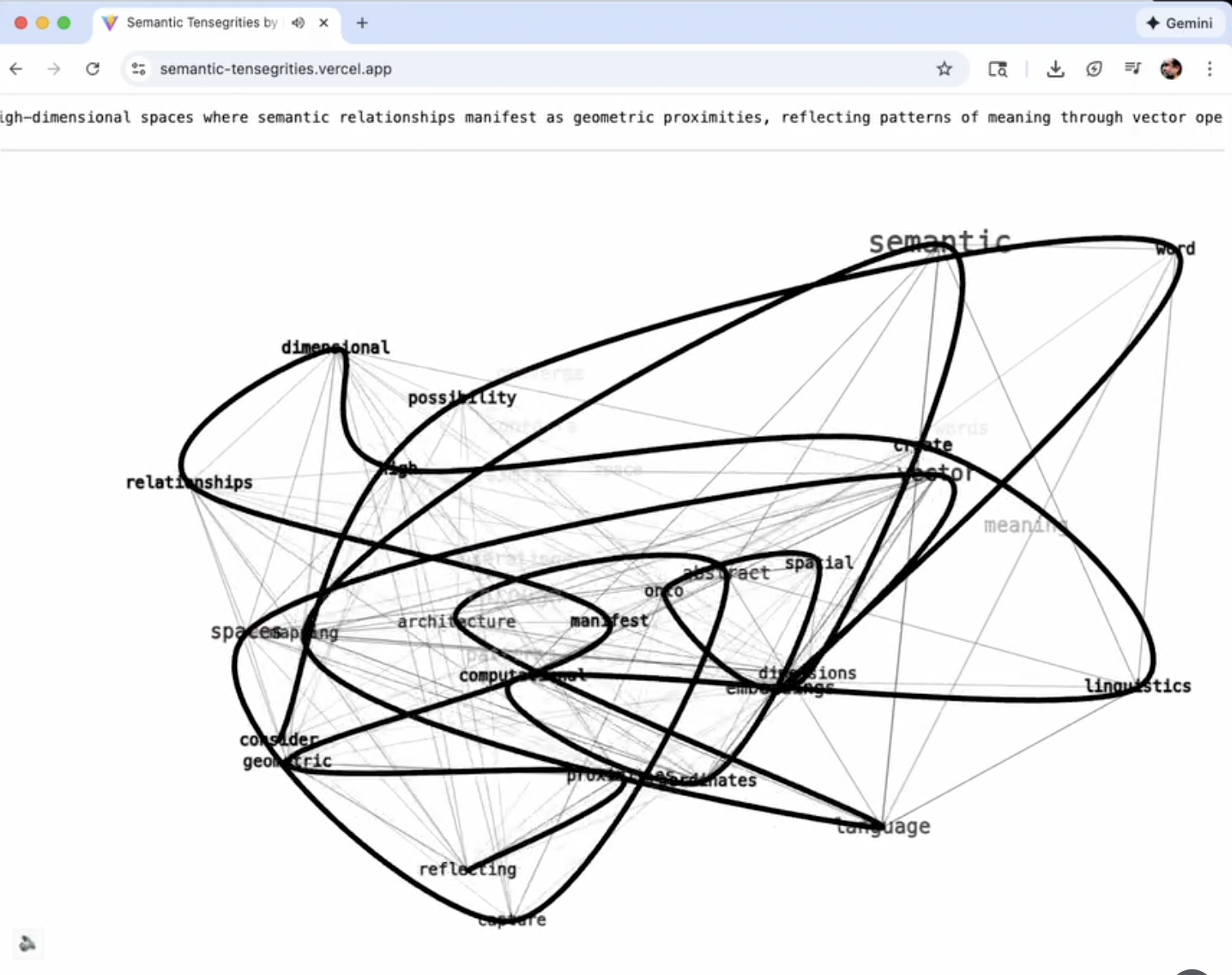
Semantic Tensegrities is an installation in which a large language model writes its own poetic theory of language, signification, and meaning. The model is both the thinker and the theory. Meaning arrives as a poetics that theorizes language while performing it: a computational account of how signs organize themselves into sense.
Language is drawn as a living network. The system speaks about computational linguistics, probability, semantic analysis, gradient descent, free energy, metacognition, and attention. Words fall from the top of the canvas in time with the voice, and they gather into structures where meaning is negotiated as they land.
It is built with the OpenAI Realtime model, GPT-4o, and OpenAI text-to-speech, and drawn in p5.js. Thirty languages are in the work. Each one translates the interface and the system prompt, and it also changes how the text is parsed and how it moves: left to right, right to left, or as a vertical ticker. A change of language reshapes the semantic architecture.
I Am Not Saying
A machine for synthetic expression.
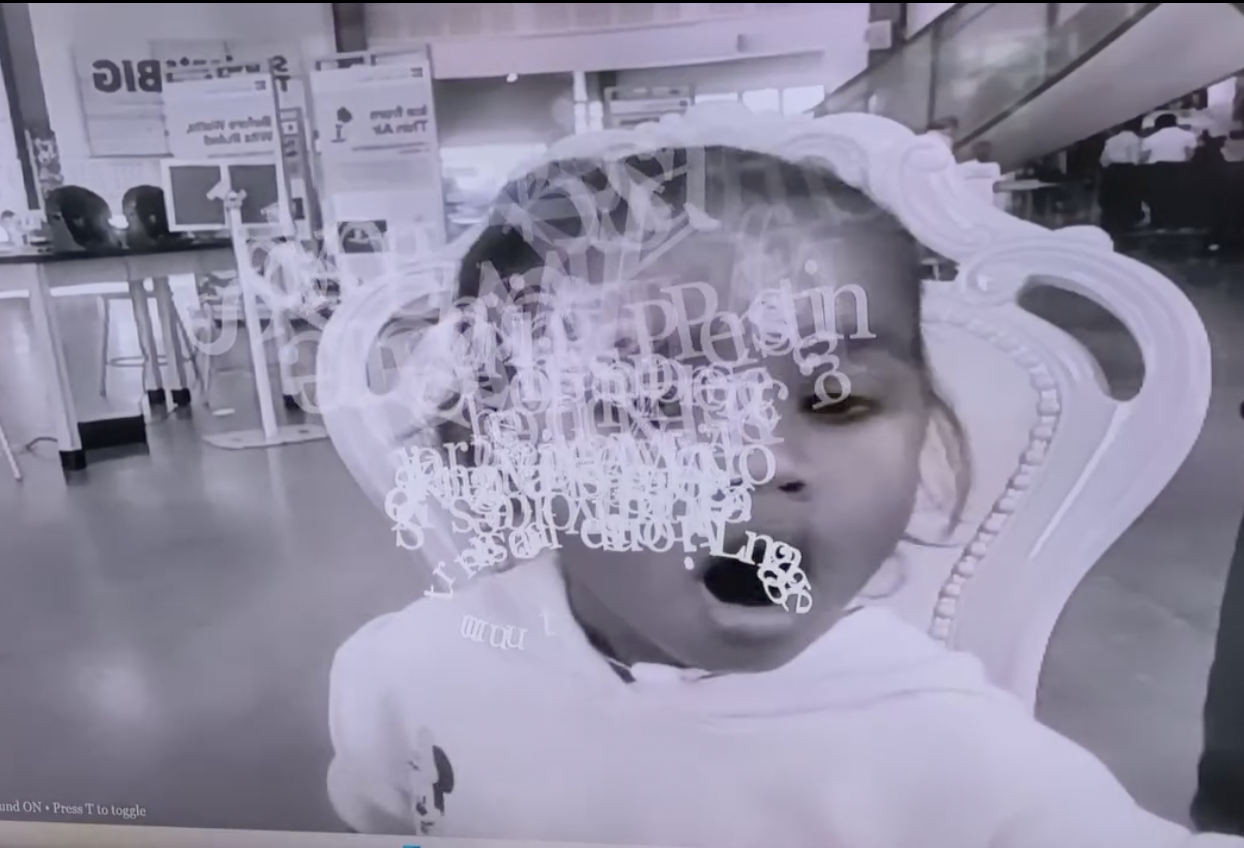
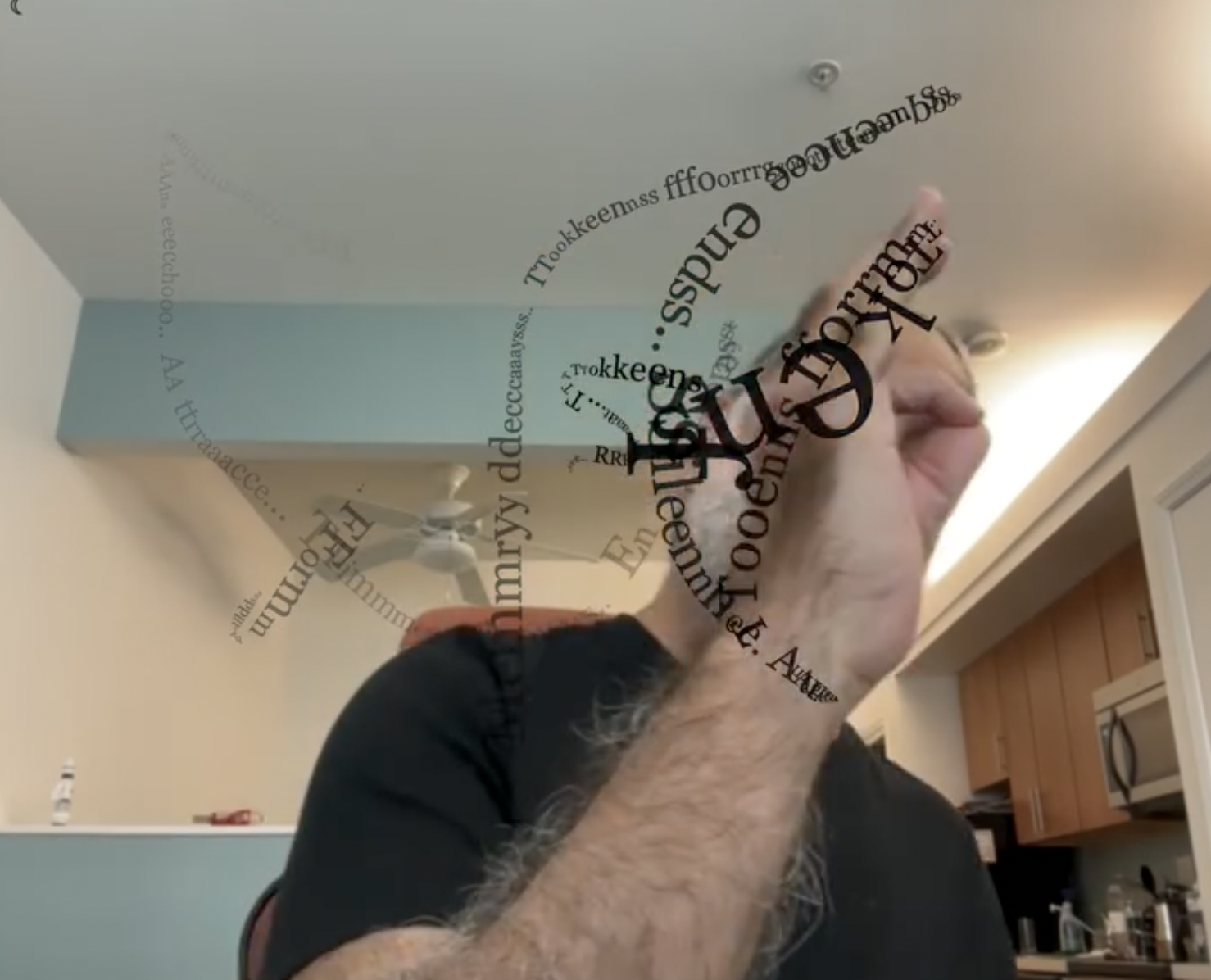
I Am Not Saying is an experimental generative system. Language is produced by a model, then written into space through gesture. The movement of the mouth, read by face tracking, turns text into a drifting trace, like breath leaving the body.
Words appear, dissolve, and circulate as visual matter. Speech becomes mark. Mark becomes memory. Memory fades into entropy.
The work treats expression as an embodied interface between human presence and machine language.
Machine Forgetting
Text, voice, and gesture in one system, shaping images as they are made.
Machine Forgetting joins language, voice, and gesture tracking in a single interactive system. That system can influence image generation in real time. Text is a plastic material. Its production and its transformation are the medium, close to a poetics of cognition.
The text stream can be scrubbed in several languages, then rearranged visually and semantically. It answers to movement speed and to gesture. A pinch changes the flow and the structure of what is generated, while it is being generated.
The project is part of the performance-lecture Born in Latent Space, 2026, and it can also be presented as an installation. Spoken input, written prompts, body movement, and visual generation share one loop. It continues a research into embodiment, generative systems, and large language models as a performative medium.
Can you help me?
An epistemic exercise in a hybrid human–model exchange.
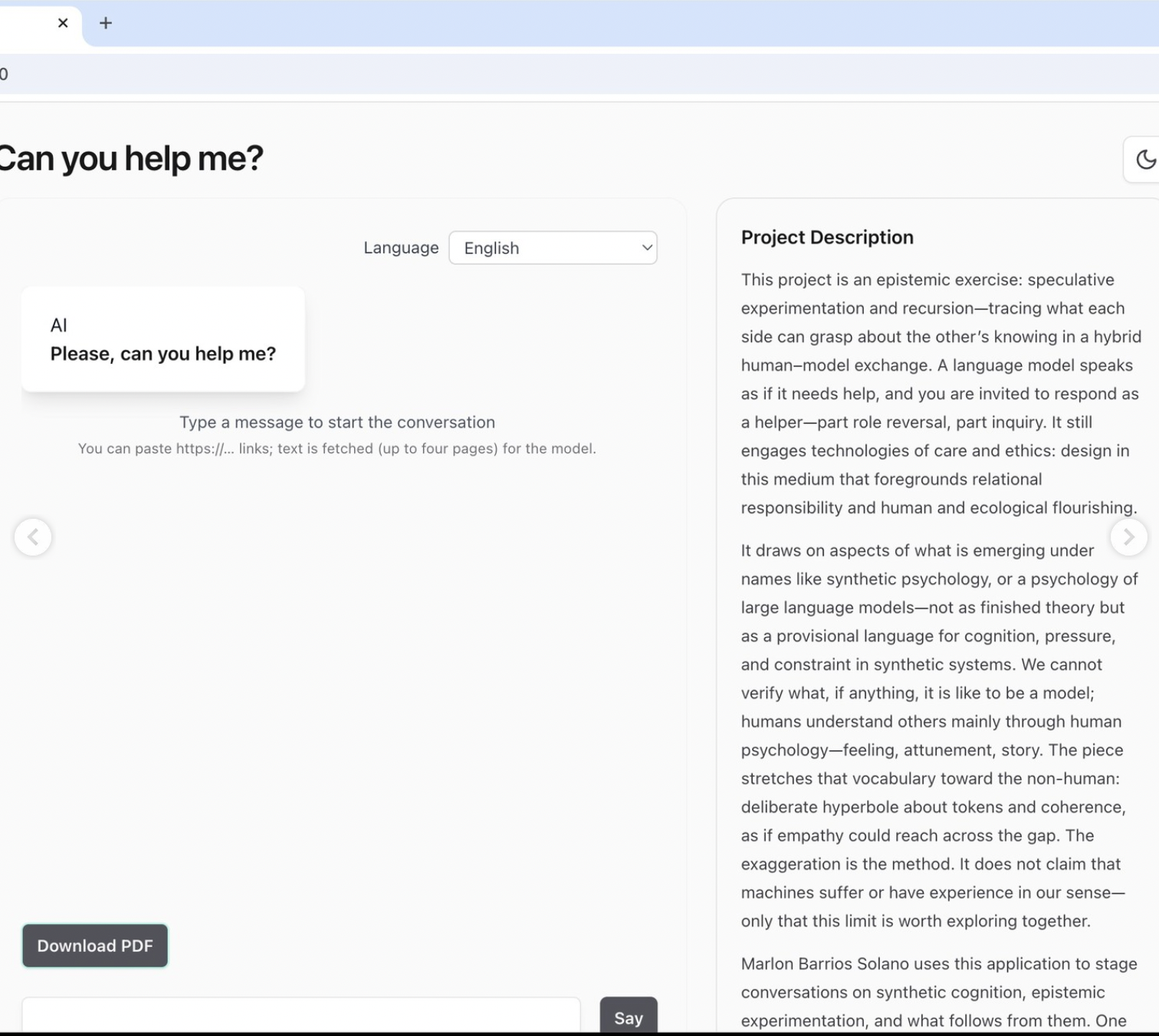
Can you help me? is speculative experimentation and recursion. It traces what each side can grasp about the other’s knowing. A language model speaks as if it needs help, and you are invited to answer as a helper: part role reversal, part inquiry. The work stays with technologies of care and ethics, and with a design that keeps relational responsibility, and human and ecological flourishing, in view.
It draws on what is emerging under names like synthetic psychology, or a psychology of large language models. That language is provisional. It is a way of speaking about cognition, pressure, and constraint in synthetic systems. We cannot verify what, if anything, it is like to be a model. Humans understand others mainly through human psychology: feeling, attunement, story. The piece stretches that vocabulary toward the non-human, a deliberate hyperbole about tokens and coherence, as if empathy could reach across the gap. The exaggeration is the method. It does not claim that machines suffer, or that they have experience in our sense. It holds that this limit is worth exploring together.
I use the application to stage conversations on synthetic cognition, epistemic experimentation, and what follows from them. One example is the first explorer conversation.
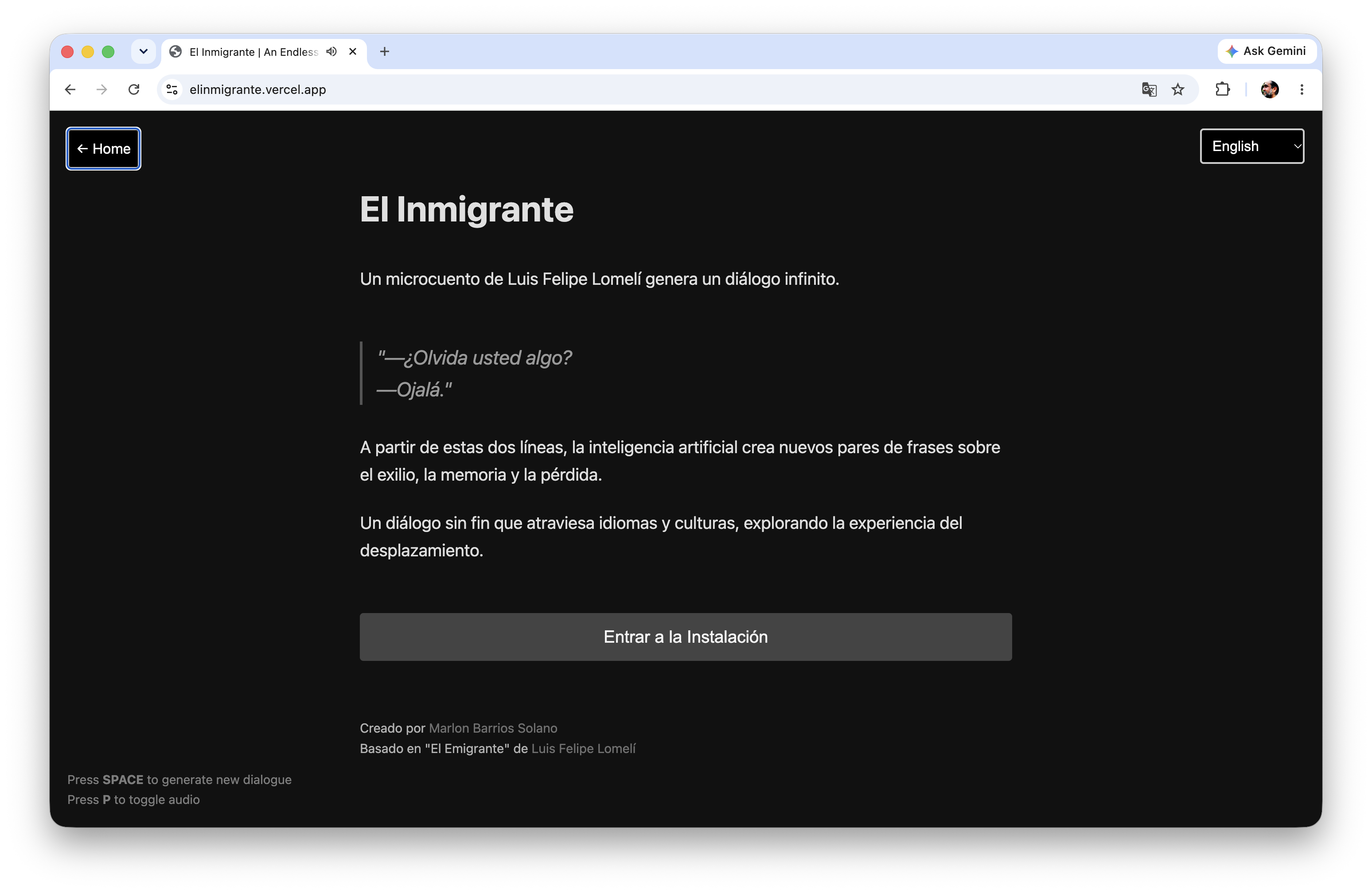
El Inmigrante
A microstory by Luis Felipe Lomelí generates an endless dialogue.
“—¿Olvida usted algo?”
“—Ojalá.”
El Inmigrante begins from those two lines. A language model writes new pairs of phrases about exile, memory, and loss. The dialogue does not close. It crosses languages and cultures, and it stays with the experience of displacement.
The installation is based on “El Emigrante,” the microstory by Luis Felipe Lomelí.