Interactive Generative Videos
A collection of works that combine video made earlier with AI, each one drawn from the concept of its installation. The music is also made with AI. I designed it, and I am responsible for the concept and the programming. In the browser the same video loads into p5.js and becomes interactive. Press A to automate. Press Space to play. Some of the live pieces keep further instructions in the top-left corner.
In a gallery or an exhibition they can run as single-channel generative video that changes by itself, or stay interactive so the audience can play them. I sometimes bring them into Born in Latent Space. Placed together in a room, as an assembly, they are what I call a stable landscape.
Relentless Epistemic Acts
Single-channel video installation · Interactive / generative version
Relentless Epistemic Acts explores image, sound, automation, and the relentless production of knowledge. Black-and-white techno vectors swarm across the frame. Generative layers react to sound. A crosshair replaces the cursor. The video becomes a shifting field of signals, interruptions, intensities, and computational decisions.
You can perform the system by hand, or give control over to it. In automate mode, the system keeps selecting and recombining visual states, answering partly to sound and partly to weighted randomness.
The video was made with AI from one image of a performance. The music is also made with AI. I designed it, along with the concept and the programming. Built with p5.js and the Web Audio API.
An epistemic act that doesn’t settle into knowledge, but keeps producing conditions for knowing.
I am interested in the interface as a site of performance.
- Who acts?
- Who decides?
- What does the system perceive?
- What kind of knowledge emerges from the feedback loop between human, image, sound, code, and machine?
Keys
- G — generative effects
- V — vector swarm
- S — solarize
- Z / F — zoom in and out
- A — automate: let the system compose
- Space — play and pause
Enter the live pieceOpen-source code
Barely There / I Am Home in Latent Space
An interactive video and generative installation
Barely There / I Am Home in Latent Space unfolds as an ASMR song. The lyrics drift through latent space while generative visuals respond to sound, playback, and interaction. Every session makes a different visual composition.
There are two ways to enter it. Press A for automated mode, and the system keeps generating visual scenes. Press Space to play, then use the controls in the top-left corner for generative effects, vectors, solarization, zoom, looping, and recording.
A recording made while interacting with the piece can be sent back. The work is available to present as an installation, a performance, or an exhibition.
Enter the live pieceOpen-source code
Boys Will Be Proud
A satirical AI-generated anthem
Boys Will Be Proud is an interactive audiovisual installation about fragile masculinity, grievance politics, and the performance of nationalism. Two synchronized versions of the same figure appear, the second mirrored, an encounter with a reflection that refuses self-recognition.
The work begins frozen. Press Space to set it in motion. Press A for an audio-reactive mode: red and blue saturation pulses with the soundtrack, the colors of the flag, without distorting the image. Lyrics scroll along the bottom, turning political rhetoric into karaoke, and showing the choreography of nostalgia, resentment, and identity.
Interaction, repetition, and spectacle shape a contemporary political imaginary.
“We’re not angry—just Boys, and Proud.”
All Watched Over by Machines of Loving Grace
Single-channel video installation · December 2024
All Watched Over by Machines of Loving Grace is AI-generated video art inspired by Richard Brautigan’s 1967 cyber-utopian poem, seen again through algorithmic surveillance. It stays with the tension between techno-optimism and the surveillance encoded in machine learning.
The voice of Richard Brautigan is sampled from Adam Curtis’s series of the same name. These are the first prototypes for “In the Eye of the Beholder.”
We Came to Rule
A dark anthem of conquest
We Came to Rule reimagines the Valladolid Debate as a techno-oratorio of domination and denial. Gregorian chant dissolves into thunder, and the voice of empire names itself eternal: a crown, a sword, a divine flame that claims the world. The lyrics follow the logic of Sepúlveda’s argument, in which Indigenous peoples are framed as children, beasts, bodies without souls, a theology of conquest that sanctified extraction, servitude, and death in the name of God and empire.
Proclamations of “natural dominion” sit against relentless beats and fractured chants. Marching rhythms carry colonial violence. Sampled Latin phrases expose the juridical and theological scaffolding that legitimized genocide: Imperium sine fine, empire without end; Dominium naturale, natural dominion; Ex cathedra, from the throne itself. “This world is ours” is chanted as a weaponized mantra. The piece is a critique, a sonic archive of arrogance.
The images were generated with AI from 15th-century German cartography. Early imperial maps become fractured, pulsating landscapes. Maps become scars, chants become errors, and empire shows itself as an unstable signal.
The track is part of Pangea in Latent Space and The Tectonics of Otherness, and it belongs to Dark Enlightenment and the Techno-republic playlist. It was made as synthetic media for the Decolonizing the Digital Residency of Pangea IA, which I led with María Luisa Angulo.
We came not to ask, but to rule.
Glitch Sanctum
An interactive audiovisual installation and performance system
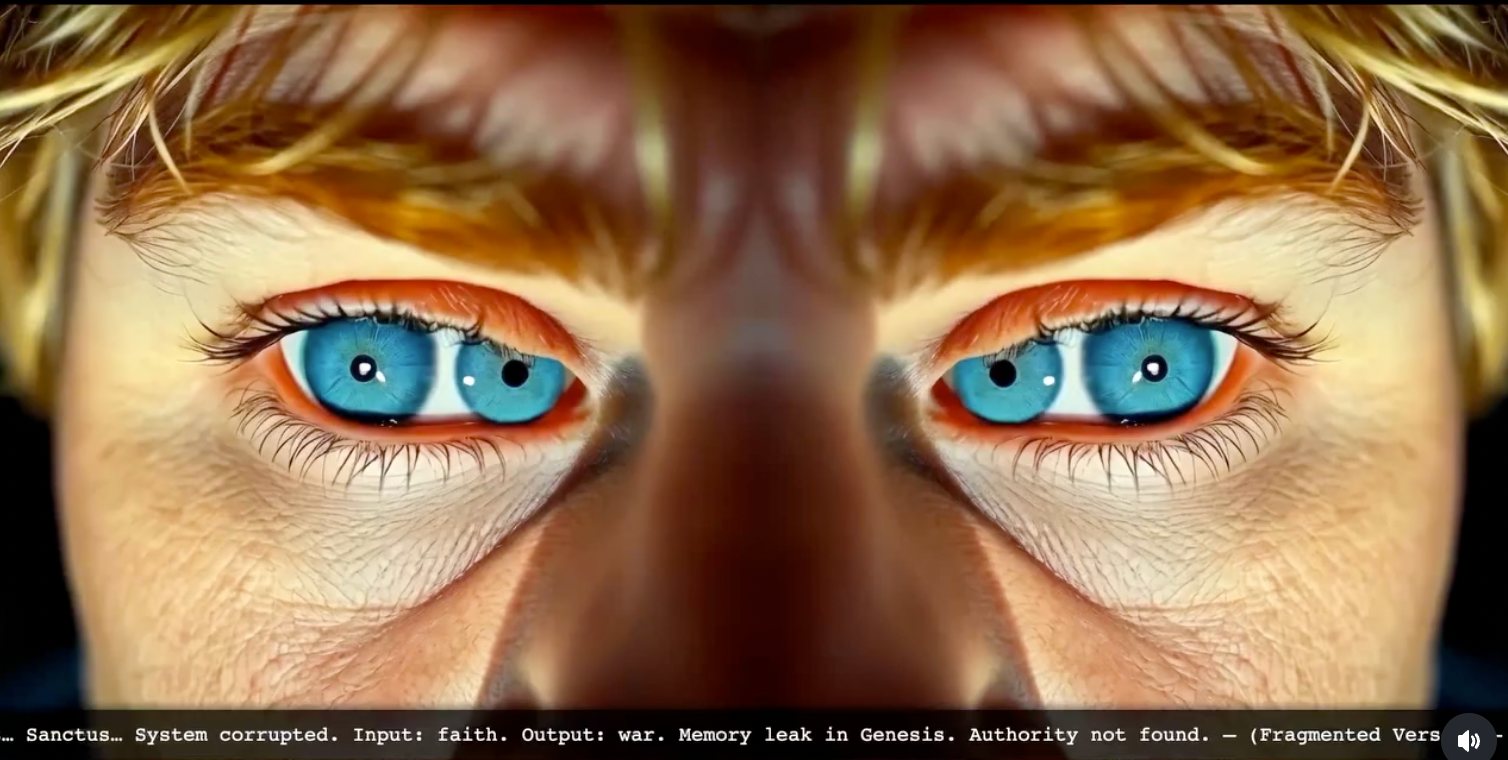
Glitch Sanctum stages a corrupted liturgy where ritual, code, sound, and moving image collide. A dual mirrored video becomes a site of continuous transformation. Fragments split into RGB channels, pulse with the music, pixelate, rotate, fracture, and reassemble in response to an autonomous audiovisual system.
The scrolling text unfolds as a broken hymn, a meditation on authoritarianism, technological power, white supremacy, propaganda, and the fragility of belief in an age of algorithmic mediation. The glitch is a space for critical reflection and aesthetic resistance.
The film records one iteration. Every performance is different, shaped by real-time audio analysis and generative visual processes that keep rewriting the image and the sound. Press Space to play. Press A and the system continues on its own. Further instructions sit in the top-left corner of the live piece.
Sanctus… System corrupted. Input: faith. Output: war.